Saturday, 3 March 2012

A Monkish Adventure

In October, our good friend, Liam, was again in Edinburgh to visit his girlfriend, Pip, and Matthew and I had tons of fun hanging out with them.We (Pip, Liam & I) talked of the 4 of us taking a road trip somewhere and connived to surprise Matthew with a day trip to Lindisfarne Island (also known as Holy Island), in the North of England.  It is a tidal island whose 2 biggest attractions are: a ruined priory and a wee castle.  Those of you who know Matthew will immediately see why he wanted to visit!

The only day that would work for all four of us was October the 22nd so we looked up tide times for that day.  It was safe to cross over to the island between 00:45 and 9:30 and then to cross back between 13:40 and 21:50.  So Liam booked the car and I wondered how on earth I was going to get Matthew to go to bed at 9p.m. on a Friday night so that we could get up at 6a.m. on a Saturday.  Not an easy pitch!  I eventually had to tell him Friday night what we had schemed and Matthew was very surprised and happily went to bed early.

We awoke before sunrise, packed our snacks, camera and outerwear (an island in October is bound to be chilly) and set off around 7:40a.m.  Liam did a brilliant job at driving stick with the wrong hand on the opposite side of the road and we were treated to a very beautiful sunrise and hills dappled with sheep on our journey.  At 9:10 we sped across the causeway, praying the the tidal charts were very accurate in their timings!  Once safe across we parked, bundled up and head off into a beautiful day.

The first order of business was getting breakfast for Pip and Liam (who had not eaten) and second breakfast for Matthew & I (who had).  We dined at a wonderfully quaint and homey cafe that seemed to partially be decorated with a maritime theme and partially just cluttered with "old stuff".  It was wonderfully eclectic in any case.  We all loved the lobster claws bedecking the walls.

After breakfast we set out to the post office (for the requisite cash) and then to wander on to the priory.  Because the tide times were so early, the island was sleepy and peaceful.  We felt like we had it all to ourselves and enjoyed taking in the quaint, quiet streets.

Quiet streets of Lindisfarne

Gearing up.

Pip is so excited!

A sleepy street.


We found a garden beside the post office.

Pip and Matthew examine the cross in said garden.

A peaceful little cottage.

 After our little nosey about we arrived at the Priory.  Because of the early tide times we had it almost all to ourselves.  It was just us, the blue skies, sunshine and puffy white clouds, which made for great photos.  I was sufficiently bundled against the island's winds so that they were not a problem.  We climbed all over the place taking shots of the exquisite architecture and each other.  A highlight for me was finding traces of the biggest bake oven I have ever seen!  I could lie down in the circle (hopefully no one ever did that while it was fully functional...).  I also liked looking out at the skyline - or rather lack of it.  Just sky and water and and beaches and fishing boats.

The Rainbow arches of Lindisfarne Priory


Pip, Liam, and Matthew admiring the entrance wall of the Priory.

Admiring the pattern in the stonework.


Cotton ball clouds!


A most gigantic bake oven.

A man in ruins.

Silly  shot!

Silly shot!

All of us jumping high in the air - oh yeah - except me!

When we had worked up a sufficient appetite from doing ridiculous things like cartwheels amongst the ruins and a photo shoot with Liam's amazing camera of all of us in mid-air, we had lunch in a quaint house-turned-restaurant where we ate upstairs in one of the bedrooms and the bathroom had a shower in it!  When we emerged after our meal our sleepy little island that we had all to ourselves had vanished and we found instead streets heaving with tourists.  The causeway had opened up again.  We found refuge in the Lindisfarne Gospels Museum, to learn more about what makes Lindisfarne so famous (those gospels and the mead).  Pip got some good research done for her paper on the gospels,  we got to do some brass rubbings, Liam had a close encounter with a Viking and in general fun was had by all!

A narrow escape.


After that we made our way to the tip of the island to the story book castle perched atop the hill.  We were rewarded with amazing panoramic views of the island and sea.  When we had finished our tour of the castle we enjoyed watching the sun set from the upper level parapet.

A storybook castle amidst the fishing boats.

Lindisfarne Castle

View from the top

Loved the rocky coastline

All of us at the castle

I still love that there are sheep EVERYWHERE once you get outside of cities.  Even on little islands.

An old fishing boat finds new life as a shed.


All in all, it was an amazing day out with amazing friends and I highly recommend the site to any visitors to the UK.


Sunday, 30 October 2011

Victorian Christmas Traditions

I recently had to give a five-minute presentation on a topic of my choice for a job interview.  I thought I'd let you all read my presentation below as I think that the topic is of interest to all.  Happy reading!

The Victorian era holds special fascination for me because it is often thought of as a time so different and old-fashioned from our own that there is nothing to relate to.  However, when I look at the Victorian era I see so many similarities.  I would like to explore one of these similarities today – specifically that of Victorian Christmas traditions that we still practice today.
One of the most enduring Christmas traditions to come out of the Victorian era is the Christmas tree.  Setting up Christmas trees in one’s home and decorating them was a German tradition.  When Queen Victoria married the German Prince Albert, one way for the royal couple to make Albert feel at home in Britain was to adopt some of his traditions, one of them being to set up a tree in Buckingham Palace at Christmas time.  In 1848 the Illustrated London News published an image of the Royal couple around their tree with their children.  Because Victoria was the equivalent to a modern movie star in her ability set trends and to make the public go wild over her, when the British public, and in turn the British colonies, learned of this practice they had to imitate their Queen.  And so happened the adoption of a German tradition into not only British practice, but into a world-wide phenomenon.  We don’t all necessarily decorate our trees with paper chains, popcorn & cranberry strings, candles, and placing presents in the boughs as was common in the Victorian era, but we do modern equivalents of tinsel garlands, electric Christmas lights, and putting presents under the tree.

1848 image of Queen Victoria, Prince Albert and their children that was published in the London Illustrated News
Another wildly popular Christmas tradition that began in the Victorian era is the sending of greeting cards to friends and family.  The first-ever Christmas card was commissioned by the Londoner Sir Henry Cole and sent in the year 1843.  The card was designed by John Callcott Horsley and showed a family drinking wine together.  The card may have started out as a marketing trick by Cole, trying to drum up more business for the penny post that he had been influential in establishing (another great Victorian invention), but the practice stuck and millions of modern families still send cards to loved ones far and near as a way to keep in touch.

First-ever Christmas card that was made and sent in 1843
 The Victorian era also lives on in the Christmas carols we sing, so many of which were penned in the 19th century.  Some examples of carols that have their origins during Queen Victoria’s reign are: Angels from the Realms of Glory (1816), Angles We Have Heard on High (1862), Away in a Manger (1865), We Three Kings of Orient Are (1863), and Good King Wenceslas (1853).  I know that, for me, the Christmas season really begins when I decide to start listening to carols at home, and we would be much poorer for choice were it not for the Victorian carol writers.
 The last issue I want to discuss is Santa Claus.  Santa Claus is an interesting figure who has roots in many cultures and is known by many names, but I would argue that the modern, western perceptions of who Santa Claus is and what he does were solidified in the Victorian era.  St. Nicholas was made popular in the 1823 poem, A Visit from St. Nicholas, which appeared anonymously in the New York Sentinel.  The poem was later attributed to Clement Clarke Moore and we now know it as ‘Twas the Night Before Christmas’. It establishes the modern ideas that Santa travels by sleigh pulled by reindeer, comes down chimneys, and is plump.  In 1881 the famous cartoonist Thomas Nast drew an image of Santa Claus that was published in Harper’s Weekly that even further cemented the image of Santa as a plump, jolly old bearded man who brings gifts to children on Christmas Eve.

Nast's famous 1881 cartoon of Santa Claus that appeared in Harper's Weekly

 
I hope that because of these examples you too can see the relevance of the Victorian era and how its traditions and ideas continue  to live on in our everyday 21st century lives.

Sunday, 18 September 2011

Having Fun in Our Own Backyard

Matthew & I had wanted to visit Craigmillar Castle for a while, but after we got our Historic Scotland passes, we finally had enough motive to actually figure out how to get there and so we planned an expedition.  One sunny Sunday afternoon, five of us intrepids set out to walk there from the city centre, picnic lunches in hand.

None of us had been, so we felt like quite the explorers as we first had to brave a long, dark, seemingly endless tunnel (that had very atmospheric damp and dripping walls) before we tumbled back into the sunshine of an expansive meadow on the other side. We walked along the tramped-out path admiring the wildflowers and the brave among us scrambled up rocks until we finally came to the castle itself.


We are not so sure about the tunnel we have to journey through...

Those of us not afraid of heights scaled this rock on our meadow walk.

Finally, we see our destination - Craigmillar castle.


It is in ruins, its battlements wind and rain-swept.  This made it all the more fun to have a picnic inside its walls while still being able to enjoy the warmth of the sunshine.  Plus, that particular day boasted a visiting falconry display!  Matthew got to hold a falcon, which was a dream of his.  I was in charge of the photographic evidence since there was NO WAY I was about to hold a falcon!

Enjoying the sunshine on full stomachs after our picnic.

A very pleased Matthew holding a falcon.


We enjoyed scrambling bout the ruins and found lots of fun nooks and crannies on our way up to the ramparts.  When we finally made it up to the top we were rewarded with stunning views of the city. We were all quite impressed with how far we'd walked... and we all resolved that we'd take the bus home!

The intrepid adventurers!

Any guesses as to what this wee, chained chamber was?


A cupboard?  Maybe?

Three lassies in a fireplace.

A view from the top.

A roof in ruin.

Look how far we walked!  Arther's Seat with the City Centre off to the left.


 After our view from on high, we took a tour round the outside at ground level.  I do so love a ruined castle!  They seem to have so much more character than intact ones.  Plus I am a sucker for all things Romantic and Tragic.

I really liked how the foundations look kind of like tree roots here, anchoring the castle through the winds of centuries in their firm grasp.

I liked the outline of this bit of wall.


Oh, and they have a really great gift shop that we had a little too much fun in. :)

We didn't really see how they justified selling viking helmet in the shop, but we had fun with them anyways!

Tuesday, 2 August 2011

Historic Scotland Passes + The Hoskins + Friends = Good Times!

Matthew and I have now been members of Historic Scotland for a month.  What is Historic Scotland, you say?  It is an organisation that runs hundreds of sites across Scotland consisting of everything from castles, churches and abbeys to brochs, broughs and stone circles. For an annual fee, you can gain unlimited access to all these sites in Scotland and can take in their special events as well.  Not bad, eh?

We had been considering buying the passes for a while, but because it is kind of expensive and because we hadn't ever really needed to, we had never got round to it.  But we finally took the plunge and bought them on July 2nd while a fellow Canadian was in town to celebrate Canada Day and suggested that we take in the jousting at Linlithgow Palace .  How could we resist such an offer?  So on that beautiful, sunny day we took the 15 minute train ride to the picturesque town of Linlithgow (where an entire bungalow can be rented for the same monthly fee as our flat) and took in the ruined palace.  The palace is open to the sky as a fire several centuries ago destroyed everything wooden, making it quite picturesque and also allowing the visitor to take in the surrounding loch and fields of rapeseed (canola).

Linlithgow Palace with a wee Matthew in front.

Detail of a mermaid on the Linlithgow Palace courtyard fountain - the oldest still functioning in Scotland.

The loch and town as seen from the palace tower.

The beautiful countryside and detail of the ruins.

Matthew and I up high in the sky!

Matthew and Felicity find a niche whose purpose we could not fathom.

I find a bake oven big enough to bake Hansel & Gretel in.


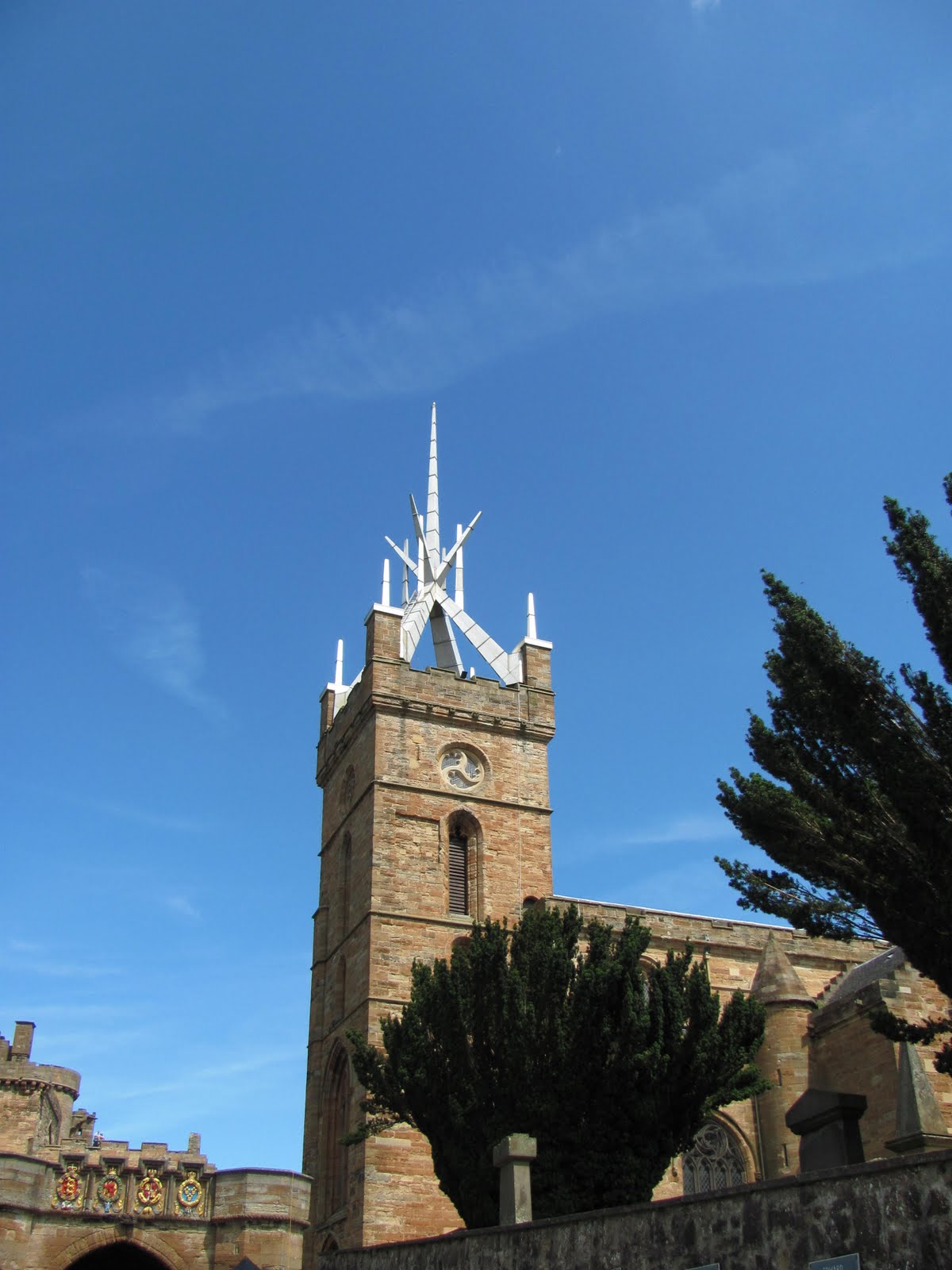
The parish church is within the grounds of the palace and is open to the public.  I enjoy its interesting steeple and it has a gorgeous stained glass window in it that I could stare at for hours!

Because I had to work on July 2nd I missed most of the jousting that day, Matthew and I decided to go back again the next weekend so that I could see the jousting.  And why not?  It would be FREE to get in!  We invited everyone we knew and about 14 of us met up for the festivities.  It was a great day.  First we took in the jousting:


And then we took in the palace...

Watch out, Sean! Megan's coming for you!

A hearth big enough for 7 ... and then some!

We ladies show off our amazing variety of boots!

Just can't get enough of that fountain!

The ruins of Linlithgow Palace

Palace courtyard from above.

Matthew with side view of Palace.
I am quite excited about our passes, as they now give us incentive to go places and see things.  This is a beautiful country that we are living in and it just got a tad more accessible. :)  I am sure many more photos of palaces and such will crop up over the next year.